Growing Careers When I Can't Promote
I've faced this challenge a few times. It's a flat organization, the firm only promotes if there is an opening, or the budget just doesn't allow it.
Three Steps
Retaining top talent takes creative leadership. Rather than relying on vertical promotions, I foster long-term engagement by expanding scope, ownership, and strategic capabilities.
I work to keep the person engaged and prepare them for a new title when it becomes available. And I take the risk that the new title might be outside of my team.
Step 1: Discover Ambitions
As part of my leadership style, I ask a lot of questions about a person's career aspirations and their ambition. It also helps me understand each individual's expectation of the future.
The middle cohort is the toughest. They want me to give them answers. And get frustrated when I tell them that a career in this field isn't a straight line. I suggest a framework for researching and learning about going deep into a specialization or staying a generalist.

Sample questions about ambition
Do you want to be a manager? A senior-level individual contributor?
What's an area that interests you that you aren't doing?
What skills do you have that are untapped?
Step 2: Clarity of Current Role
I think beyond the job description. They are too general to be helpful for daily expectations. At both AIG and Shutterstock, I started from zero. There was no clarity on daily needs for a designer and no parity across the group. We had big gaps.
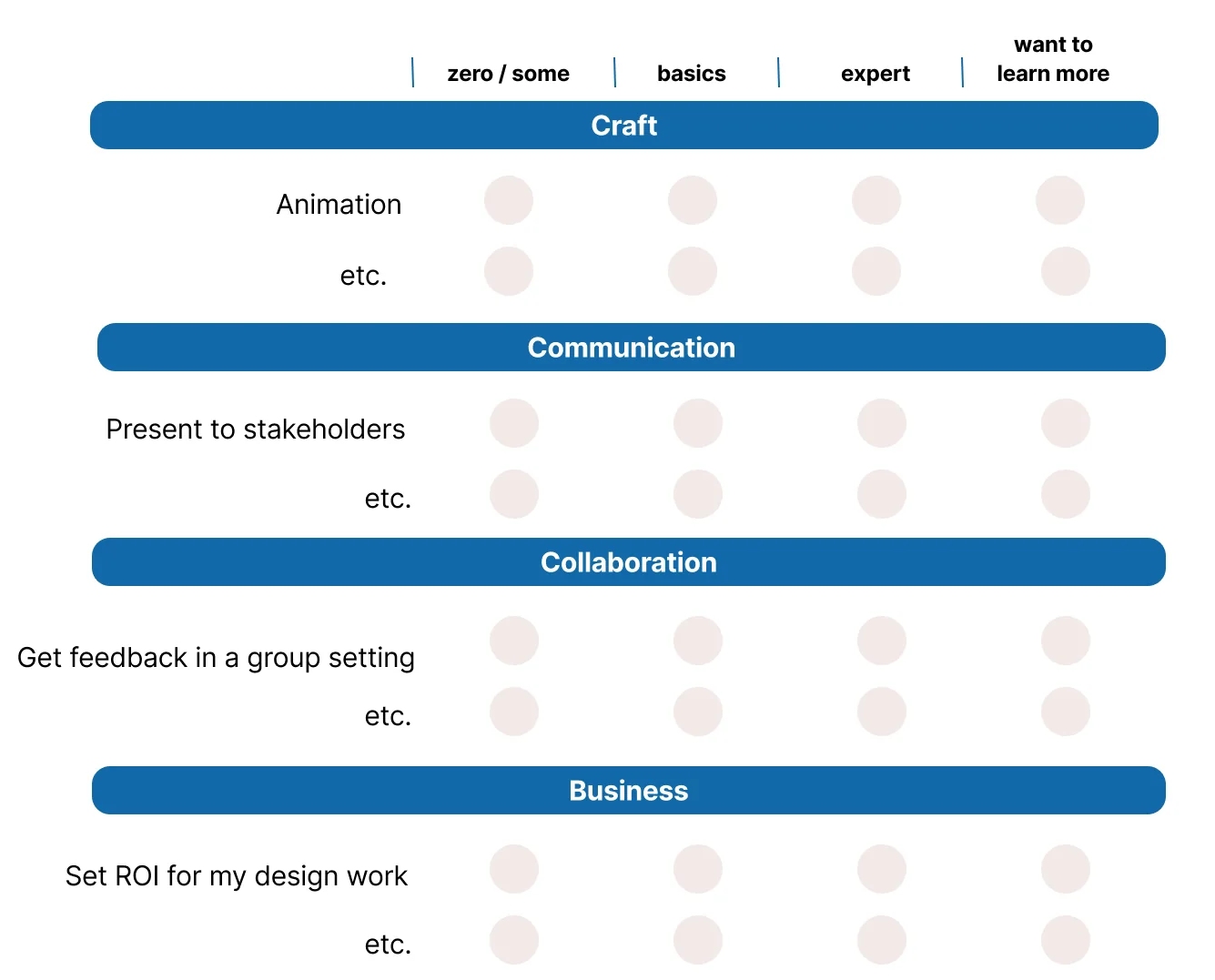
With both teams, I built a framework based on four categories. And added a collection of sub-skills. It gave the team a chance to learn my expectations and what I value from teams. I use these foundations for self-assessments and building growth plans.

Craft
T-shaped skills that include everything from user research, facilitation, process diagrams, wires/comps/code, animation, etc.

Communication
The ability to negotiate, give and receive feedback, and maintain relationships.

Collaboration
Text, diagrams, presentations - the ability to articulately convey one's thoughts. It's old but good: if you can't communicate your idea, it doesn't exist.

Business
Understand how the company makes money, the difference between growth and cost, and how to measure design.
Self assessment
I was transparent about my goal: a shared understanding so we can work together on growth and annual reviews.
This diagram generated great conversations - some of them difficult. Thinking beyond craft was difficult, and often involved activities people didn't like.
The diagram's subcategories changed based on the company. At Shutterstock, I focused on collaboration. The team had a terrible reputation and we needed to repair it.
Step 3: Growth Plan
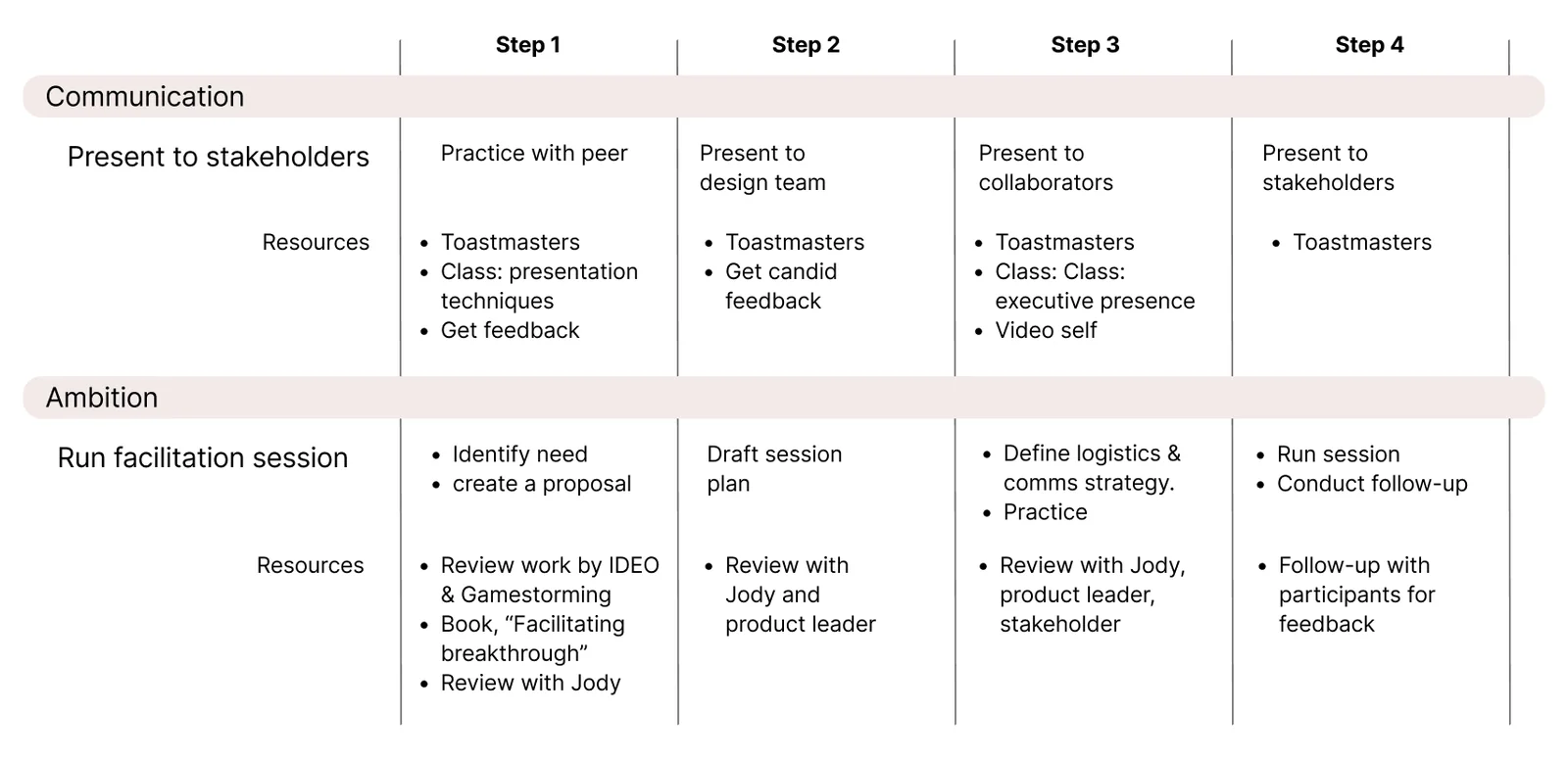
My favorite part of the process is the growth plan. I provided the framework and the most curious would come to me with a draft. For others, the process started as a conversation with me.
For annual goals, these growth areas are in addition to the project work. Although the goal is to integrate career growth into the project work. I did not want it as a separate track.
In the diagram, phases are gates to set expectations and to show when the person needs to pivot.
Setting the Stage
Change is scary, especially when it comes to roles. Before I start the process, I explain why I'm making changes and an outline of what will change.
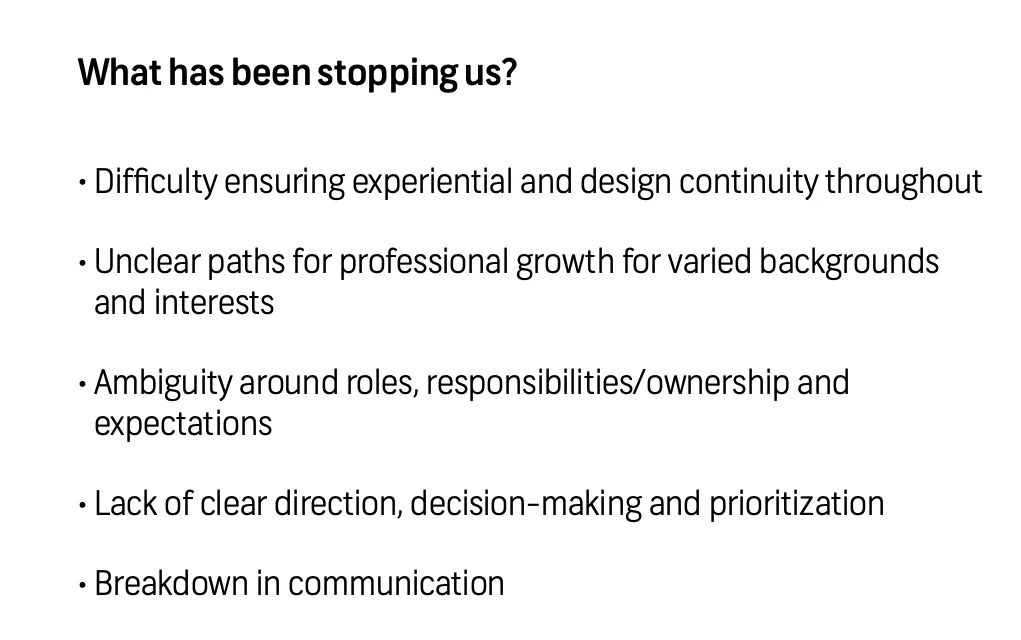
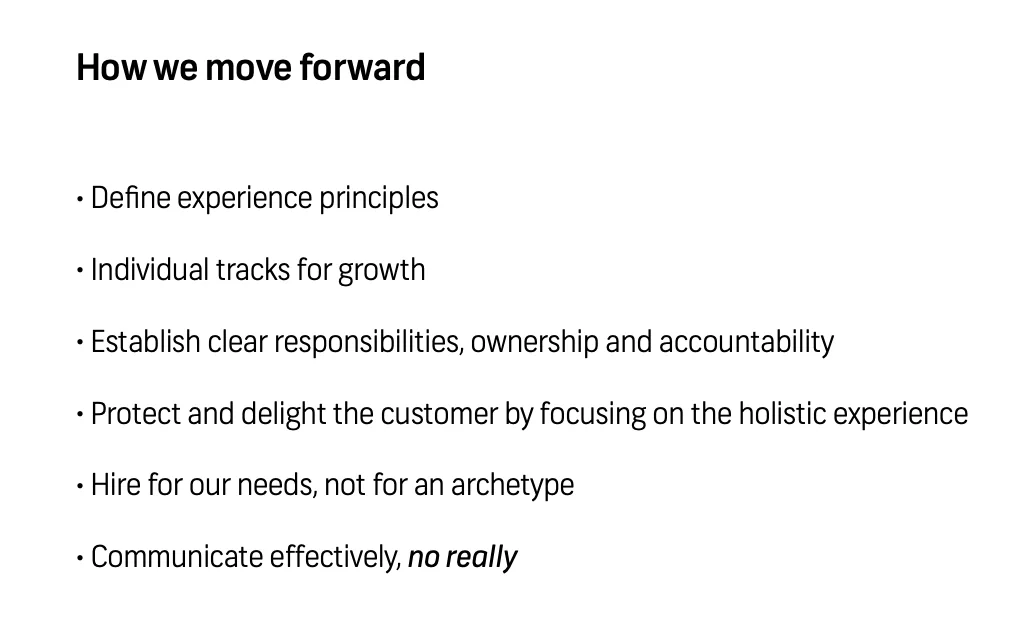
I developed these slides for a team with a terrible reputation when I joined. User Experience had no strategic role, at any level. The team morale was low and the general feeling was that the organization would be happy to see them go.
Building a strategic reputation was a full-team endeavor. In the full presentation, I share specifics, timelines, and my expectations. It worked. The team became a trusted partner, as Shutterstock went through a full-scale replatforming.